‘Baramulla Express’ Reaches Team India: Auqib Nabi Makes ODI Debut Against West Indies
By: Javid Amin | 30 September 2026
Guwahati: For years, Jammu and Kashmir cricket has produced promising names who have come close to the Indian dressing room. On Wednesday, one of them finally stepped onto the international stage.
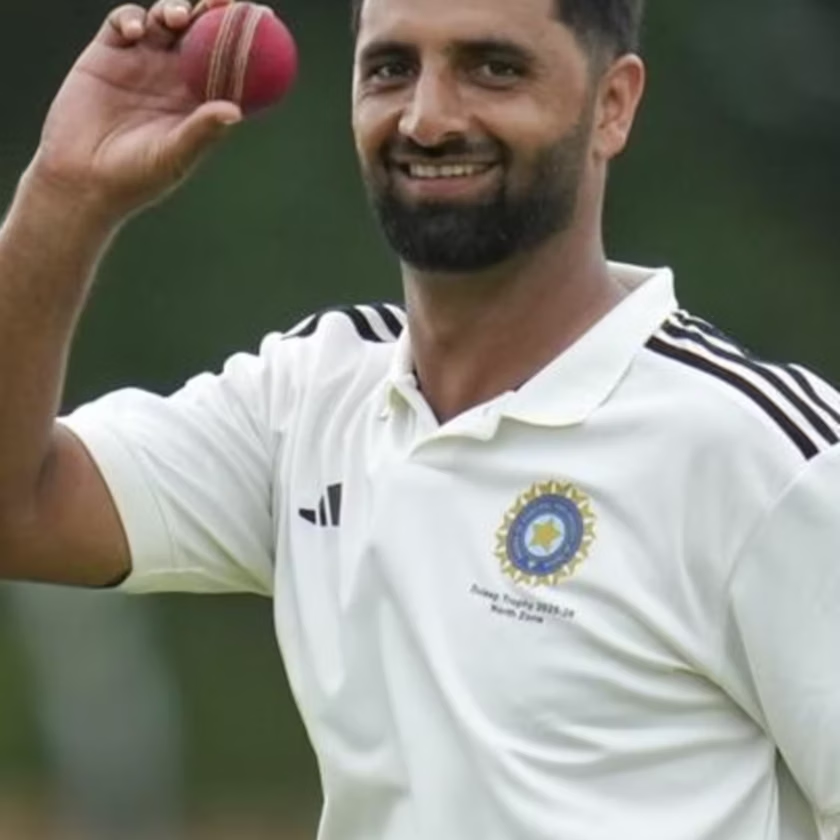
Baramulla-born fast bowler Auqib Nabi made his India ODI debut against the West Indies at the Barsapara Cricket Stadium in Guwahati, becoming only the third cricketer from Jammu and Kashmir to represent India in One-Day Internationals, after Parvez Rasool and Umran Malik.
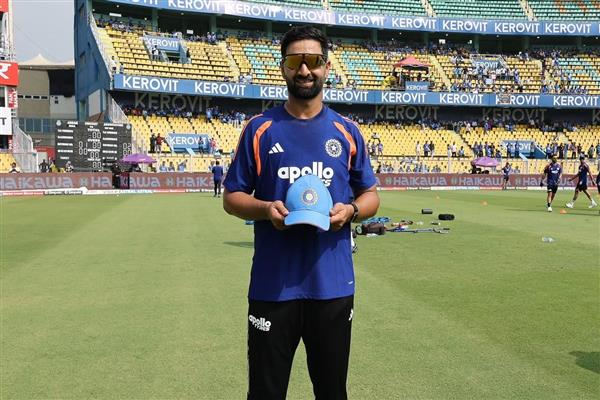
The moment came when vice-captain KL Rahul handed Nabi his maiden India cap before the second ODI. Captain Shubman Gill won the toss and elected to bowl, while Nabi came into the XI in place of Nitish Kumar Reddy.
It was a milestone that had been building for years.
But Nabi’s first international outing also offered a reminder of how unforgiving top-level cricket can be. The West Indies amassed 405/7, with three of their batters scoring centuries, and Nabi finished with 0/84 from 8.5 overs. India, however, chased down the target with 39 balls to spare, winning by eight wickets.
The numbers from one afternoon, therefore, tell only part of the story.
The larger story is how a fast bowler from north Kashmir went from domestic cricket and local training grounds to the Indian team.
From Baramulla to the India cap
Auqib Nabi, born on November 4, 1996, in Baramulla, has built his reputation primarily through red-ball cricket.
His rise did not happen overnight. It gathered momentum through performances for Jammu and Kashmir, where he developed into one of the most productive seam bowlers in Indian domestic cricket.
The breakthrough season came in 2025-26.
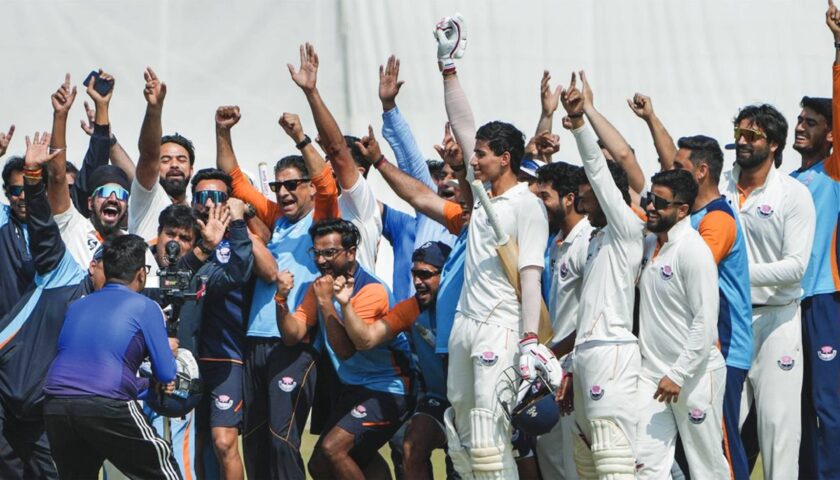
Jammu and Kashmir won their first-ever Ranji Trophy title, defeating Karnataka in the final. Nabi was central to that campaign. He finished the tournament with 60 wickets in 10 matches, the most by any bowler in the competition, and was named Player of the Series.
His final was a fitting summary of the season. Against Karnataka, he took 5/54, helping J&K establish a first-innings lead and eventually secure the championship.
That campaign changed the trajectory of his career.
The numbers were not merely impressive in isolation. Nabi repeatedly produced his best cricket when the stakes became higher, particularly during the knockout phase.
That ability became one of the defining features of his 2025-26 Ranji campaign.
60 wickets, a maiden Ranji title and a national breakthrough
Jammu and Kashmir’s Ranji triumph was itself historic, but Nabi’s individual contribution made the achievement even more significant.
According to ESPN’s final match record, Nabi was officially named Player of the Series, while his 60 wickets made him the tournament’s leading wicket-taker.
NDTV’s review of the season noted that his five-wicket haul in the final was his seventh five-wicket haul of the tournament.
His influence extended beyond one spectacular season.
Reuters reported in August that Nabi had taken 104 wickets across the previous two Ranji Trophy seasons, including the 60 wickets that helped J&K win their maiden championship. That consistency played a major role in his elevation into the national setup.
The significance of that record is difficult to miss.
Indian cricket has an enormous domestic ecosystem. A bowler can dominate one tournament and still find the road to international cricket blocked by competition for places.
Nabi instead produced sustained numbers over multiple seasons.
That made his eventual India call-up less about one sudden performance and more about a pattern.
The county cricket chapter
Nabi’s development also took him outside India’s domestic circuit.
In September, he joined Surrey for three County Championship matches during the English season. Surrey’s official announcement said Nabi had been available for matches against Yorkshire, Sussex and Glamorgan.
The move was significant because county cricket has traditionally been regarded as a demanding environment for seam bowlers, particularly in conditions that reward control, movement and patience.
Surrey noted that Nabi had taken 60 wickets in the Ranji Trophy at an average of just over 12.5 runs per wicket. The club also highlighted his previous performances for India A and his four wickets in four balls for North Zone in the Duleep Trophy in 2025.
The overseas experience added another layer to a career that was already moving quickly.
It also came after Nabi had been called into India’s Test squad for the Sri Lanka series in August, making him the first player from Jammu and Kashmir to be selected for India’s senior Test side.
He did not make his Test debut then.
The ODI opportunity, however, eventually arrived.
The India call-up was only the beginning
When Nabi entered India’s wider international picture, his credentials were heavily weighted toward first-class cricket.
That raised a natural question: could his effectiveness with the red ball translate into the demands of international white-ball cricket?
The selection against West Indies offered the first answer.
India’s team management made one change from the previous ODI, bringing Nabi in for Nitish Kumar Reddy. India opted to field first after winning the toss.
The occasion itself was unmistakable.
Nabi stood alongside established international names, received his cap from KL Rahul and walked onto an international field wearing the India colours.
For Jammu and Kashmir, the symbolism was equally powerful.
Parvez Rasool had previously broken the region’s ODI barrier, while Umran Malik followed him into India’s limited-overs setup. Nabi is now the third J&K cricketer to reach that particular landmark.
A difficult first day, but not the end of the story
The Guwahati pitch did not provide Nabi with the dream start many supporters had imagined.
West Indies attacked India’s inexperienced pace combination and eventually posted 405/7, their first-ever 400-plus ODI total. John Campbell, Shai Hope and Amir Jangoo all scored centuries.
Nabi bowled 8.5 overs and conceded 84 runs without taking a wicket.
According to the Times of India, the 84 runs were the most conceded by an Indian bowler on ODI debut, surpassing Karsan Ghavri’s 83 against England in 1975 among the relevant debut records.
That statistic will inevitably become part of the record book.
But it should not obscure the context.
This was Nabi’s first ODI. He was bowling against an aggressive West Indies batting line-up on a day when the Indian attack collectively struggled to contain the scoring rate. Gurnoor Brar conceded 96 runs while taking two wickets, while Prasidh Krishna went for 45 in five overs.
More importantly, the match demonstrated the difference between domestic success and international cricket.
There is less room for error.
Batters punish loose deliveries more consistently. Plans have to change within an over rather than over a spell. Field placements, match-ups, pace variations and execution become crucial.
For a bowler making his debut, that learning curve can be steep.
India’s batting turned the night around
Ironically, Nabi’s difficult first spell came in one of India’s most remarkable ODI batting performances.
West Indies reached 405/7, seemingly putting India under enormous pressure.
India’s response was emphatic.
Rohit Sharma scored 101, while Shubman Gill produced an unbeaten 223 as India chased down the target with 39 balls remaining. Reuters described it as the second-highest successful chase in ODI history.
Gill’s innings became the defining individual performance of the match.
The result also meant Nabi’s debut ended with an Indian victory, even though his personal figures were far from what he would have wanted.
That distinction matters.
A player’s first international match does not establish the final shape of his career.
For Nabi, the more meaningful question will be what comes next.
Why Nabi’s rise matters to J&K cricket
The significance of Auqib Nabi goes beyond the India cap.
Jammu and Kashmir cricket has spent decades trying to build a stronger domestic structure and establish itself as more than a peripheral participant in Indian cricket.
The region has produced international players before, but sustained representation at the highest level remains comparatively rare.
Nabi’s emergence comes at a particularly important moment.
Jammu and Kashmir have just won their first Ranji Trophy. Their players are attracting greater attention across domestic competitions, and Srinagar is preparing to host the Irani Cup against the Rest of India from October 1 to 5.
That means J&K cricket enters October with an extraordinary concentration of national attention.
Its Ranji champions are preparing to face a Rest of India side led by Rishabh Pant, while one of their leading performers has just made his India ODI debut.
The timing could hardly be more significant.
Nabi’s absence will also be felt in Srinagar
There is an immediate sporting consequence to Nabi’s international elevation.
He will not be available for Jammu and Kashmir’s Irani Cup meeting with the Rest of India, which begins at the Sher-i-Kashmir Stadium in Srinagar on October 1.
That is a substantial loss for the Ranji champions.
Indian Express reported ahead of the match that J&K would be without its two leading pacers, creating a significant bowling challenge against a strong Rest of India team.
Yet there is an unavoidable irony here.
Jammu and Kashmir may miss Nabi because he is no longer merely their bowler.
He is now an India international.
That is precisely the kind of progression domestic teams ultimately hope their best players will achieve.
From limited facilities to the biggest stage
Nabi’s own comments after J&K’s Ranji triumph offered an insight into the journey.
After receiving the Player of the Series award, he spoke about the hard work behind the championship and acknowledged the support of his family and people back home.
He also had a message for young cricketers dealing with limited infrastructure: work hard, put in the effort and focus on the process.
That message resonates particularly strongly in a region where cricket has immense popularity but access to elite facilities has not always been evenly distributed.
The path from a local cricket ground in Baramulla to the India dressing room is not simply a sporting journey. It demonstrates how domestic performance can create opportunities that were once difficult to imagine.
Nabi’s route has included Jammu and Kashmir cricket, the Ranji Trophy, the Duleep Trophy, India A, the IPL, county cricket and national selection.
Each step added another test.
Each exposed him to a different level of competition.
The ODI cap is therefore less a destination than the latest marker in a rapidly changing career.
The ‘Baramulla Express’ enters a new phase
The nickname “Baramulla Express” has followed Nabi through his rise, but international cricket will demand more than reputation.
His domestic record has already established his ability to take wickets consistently. His next challenge is converting that effectiveness into international performances.
The first attempt was difficult.
There is no reason to disguise that.
But there is also little value in judging an international career from one scorecard.
The history of cricket is full of players whose first appearances were unremarkable before they developed into important international performers.
For Nabi, the opportunity is now real.
He has the India cap. He has experienced the pace of an international batting attack. He has learned what an ODI at the highest level feels like.
The next stage will be about adaptation.
A new landmark for Kashmir cricket
For people watching cricket in Baramulla, Srinagar and across Jammu and Kashmir, September 30 will nevertheless remain a landmark date.
The scorecard may record 0/84 beside Auqib Nabi’s name.
It will also record something that cannot be reduced to bowling figures:
India debut.
That line represents the culmination of years of domestic cricket, a historic Ranji Trophy campaign, international exposure and persistence.
Parvez Rasool opened the ODI door for Jammu and Kashmir.
Umran Malik followed.
Now Auqib Nabi has walked through it.
His first day in India colours was difficult, but the larger journey that brought him there remains remarkable. And for the next generation of young cricketers watching from the Valley, perhaps that is the most important part of the story.
The road from a cricket ground in Baramulla to Team India is no longer just an aspiration.
Auqib Nabi has shown that, for a J&K cricketer, it can become a route.